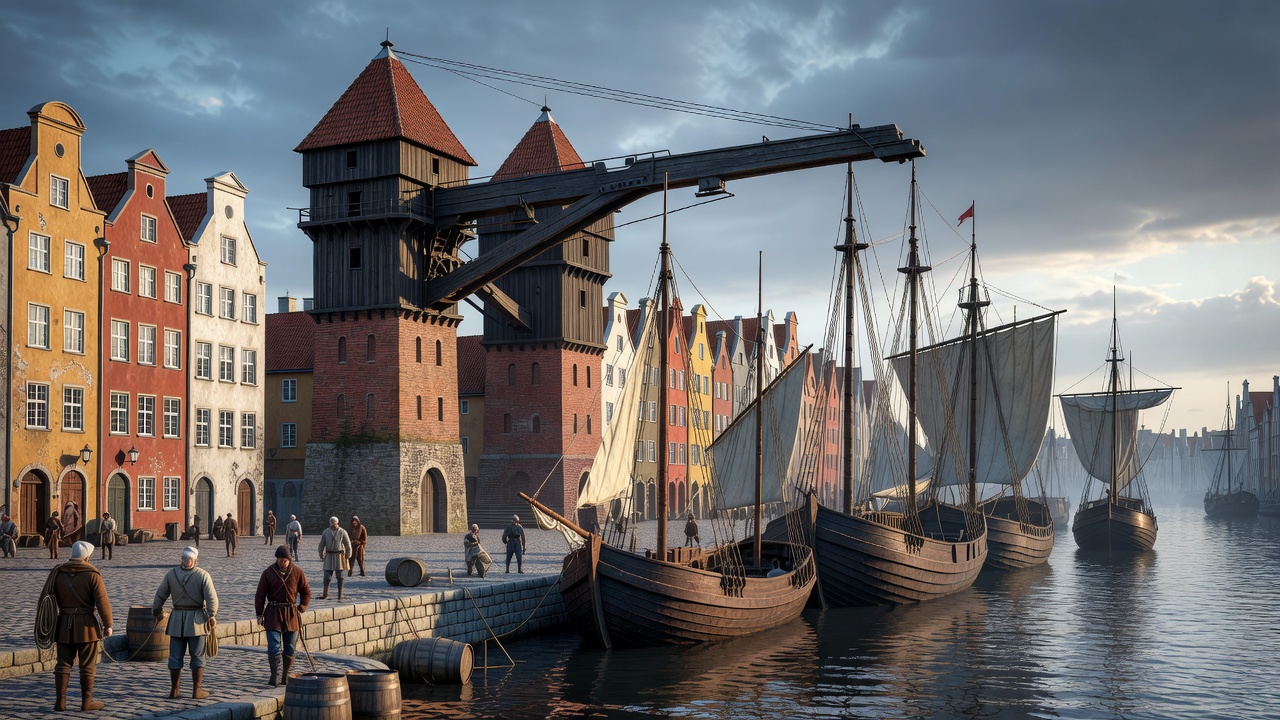
The Hanseatic Powerhouse of the Baltic
Gdańsk’s identity is permanently welded to salt air, Baltic winds, and international naval commerce. As the premier port of the Hanseatic League and the granary of early modern Europe, the city grew wealthy on Vistula grain trade. The Motława riverfront is defined by the Żuraw—a monumental 15th-century wooden treadwheel crane capable of stepping ship masts and lifting four tons of cargo, powered exclusively by men walking inside giant internal hamster wheels.
Strolling down Długi Targ (The Long Market) reveals Flemish Mannerist facades crowned with stone finials, wrought-iron drainage gargoyles, and the famed Neptune Fountain. At the end of the promenade looms St. Mary’s Church (Bazylika Mariacka), the largest brick church in the world, holding up to 25,000 worshippers beneath its cavernous white vaulted ribs and a three-story 15th-century astronomical clock.
The Sparks of 20th-Century Transformation
Few cities have determined 20th-century European destiny like Gdańsk. On September 1, 1939, the first salvos of World War II were fired by the German battleship Schleswig-Holstein against the Polish military outpost at Westerplatte, holding out against overwhelming odds for seven days.
Four decades later, in August 1980, electrician Lech Wałęsa climbed the perimeter fence of the Lenin Shipyard, galvanizing 17,000 shipbuilders to establish Solidarność (Solidarity). This independent trade union cracked the foundations of Soviet hegemony across Eastern Europe. Today, the European Solidarity Centre (Europejskie Centrum Solidarności) honors this non-violent revolution within a monolithic rust-steel building resembling a hull under construction.
The Tri-City & Coastal Wilds
Gdańsk forms an urban continuum known as the Trójmiasto (Tri-City) alongside Sopot and Gdynia. Sopot is Poland’s storied Belle Époque health resort, featuring Europe’s longest wooden pier (Molo) extending 511 meters into Gdańsk Bay. Gdynia presents sleek 1930s modernist architecture and bustling commercial container terminals.
Further out, the Hel Peninsula narrows into a 35-kilometer ribbon of wind-swept sandbars favored by kitesurfers and grey seals, while the shifting sand dunes of Słowiński National Park resemble an otherworldly coastal Sahara constantly migrating under the Baltic gales.