The Living Medieval Geometry
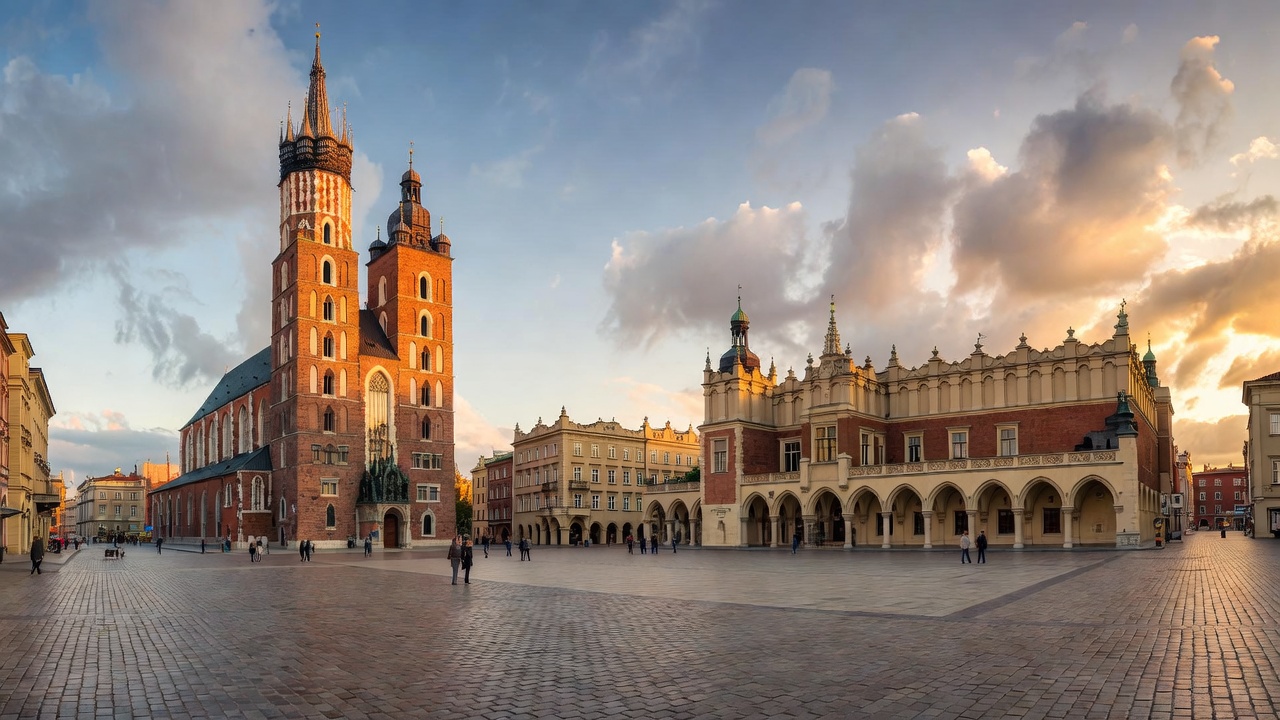
Laid out in 1257 following the devastating Mongol invasions, Kraków’s Old Town (Stare Miasto) revolves around the Rynek Główny—a vast 200-meter-by-200-meter square that remains the greatest intact medieval marketplace on the European continent. Unlike Warsaw, Kraków was largely spared deliberate aerial demolition during World War II, preserving an uninterrupted continuum of Romanesque, Gothic, Renaissance, and Art Nouveau urban architecture.
At the square’s center stands the Sukiennice (Cloth Hall), once the international trading node where Flemish textiles were bartered for Hungarian copper, ruthenian wax, and Wieliczka salt. Directly adjacent, the twin uneven towers of St. Mary’s Basilica soar into the southern Polish sky. Every single hour, a trumpeter plays the traditional Hejnał mariacki from the higher spire, the melody abruptly breaking off mid-note to honor the watchman slain by a Mongol arrow in the 13th century.
Wawel Royal Hill: Seat of Sovereignty
Rising above the sweeping bend of the Vistula River, Wawel Hill functioned for over five centuries as the political and spiritual nucleus of the Polish realm. The Royal Castle blends northern Italian Renaissance arcaded courtyards with northern Gothic fortification. Here, kings were crowned and interred in the subterranean crypts of Wawel Cathedral, flanked by national poets such as Adam Mickiewicz and Juliusz Słowacki.
Beneath the limestone cliffs lies the Smocza Jama (Dragon’s Den), an ancient cavern entangled in the pagan founding myth of King Krak and the Wawel Dragon, now commemorated by a monumental fire-breathing bronze effigy designed by sculptor Bronisław Chromy.
Kazimierz: Memory, Spirit & Rebirth
Established as an independent charter city in 1335 by King Casimir the Great, Kazimierz grew into one of the world's most vital epicenters of Jewish life, theology, and philosophy. For centuries, rabbis like Moses Isserles (the Remah) shaped Ashkenazi jurisprudence within its labyrinth of synagogues and cobblestone courtyards.
Today, Kazimierz experiences an electric cultural renaissance. Plac Nowy, the round central market square, hums day and night with travelers savoring zapiekanki (toasted open-face baguettes loaded with sautéed mushrooms, melted gouda, and spicy garlic sauce). Hidden leafy garden cafés, boutique bookshops, and klezmer performance cellars sit side by side with the Old Synagogue and the High Synagogue.
The Salt Cathedrals of Wieliczka
A mere 14 kilometers southeast of Kraków lies the Wieliczka Salt Mine, continuously mined since the 13th century until the late 20th century. Extending down to nine subterranean tiers across 287 kilometers of shafts, it houses entire chapels carved directly from gray rock salt, including the breathtaking Chapel of St. Kinga, adorned with crystalline salt chandeliers and intricate biblical reliefs.